
- Mae Walker’s headdress was inspired by the recently opened King Tut tomb
© Whenever I see my grandmother Mae’s 1923 wedding photographs, I can’t help but marvel at the elegance and extravagance. I also can’t resist searching her eyes for clues to the drama I now know was roiling just behind the scrim of the carefully choreographed scenes.
Newspaper headlines from the Pittsburgh Courier –“Heiress Weds ‘Mid Pomp-Splendor”—to the New York World—“Thousands Attend Wedding of Negro Heiress in Harlem”—tell only part of the story.

Mae Walker's 1923 wedding was the social event of the season (aleliabundles.com)
For Harlem’s social event of the season and of the year, there were parties galore, guests from three continents and a groom from a prominent family. There also was a major glitch: the bride was in love with someone else. (more…)

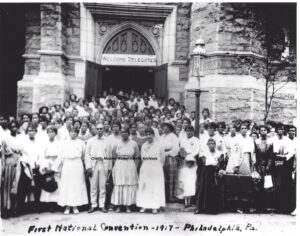
On August 31, 1917, Madam C. J. Walker hosted the first national convention of her Walker “beauty culturists” at Philadelphia’s Union Baptist Church, where a young contralto named Marian Anderson was just beginning to be noticed. More than 200 women from all over the United States gathered to learn about sales, marketing and management at what was one of the earliest professonal gatherings of American women entrepreneurs.
Walker–who founded her Madam C. J. Walker Manufacturing Company during the spring of 1906 in Denver after marrying her third husband, Charles Joseph “C.J.” Walker, earlier that year–had first begun selling hair care products in St.  Louis (more…)

Burial site of Madam C. J. Walker and A’Lelia Walker at Woodlawn Cemetery in The Bronx
June 30, 2011: Secretary of the Interior Ken Salazar today announced that The Woodlawn Cemetery in The Bronx–where entrepreneur Madam C. J. Walker and her Harlem Renaissance arts patron daughter, A’Lelia Walker, are buried–has been designated a National Historic Landmark, the highest recognition accorded to the nation’s most historically significant properties.
There are two other National Historic Landmarks associated with the legacy of the Walker women: The Madam Walker Theatre Center, a cultural arts organization in Indianapolis, and Villa Lewaro, the home Madam Walker built in Irvington-on-Hudson, New York in 1918. Villa Lewaro was added to the National Register of Historic Places in 1976. The Walker Theatre was added to the National Register in 1991.
Madam Walker died on May 25, 1919 at Villa Lewaro, where her funeral was held on May 30. Among the pallbearers were New York Age publisher Fred Moore, composer J. Rosamond Johnson, and Alpha Phi Alpha founder Vertner Tandy, Villa Lewaro’s architect.

Pallbearers for Madam Walker’s 1919 Funeral (Madam Walker Family Archives/www.aleliabundles.com)
A’Lelia Walker,who held a private ceremony for her mother at Woodlawn on June 3, 1919, was herself buried there in August 1931. (more…)

Recent Comments